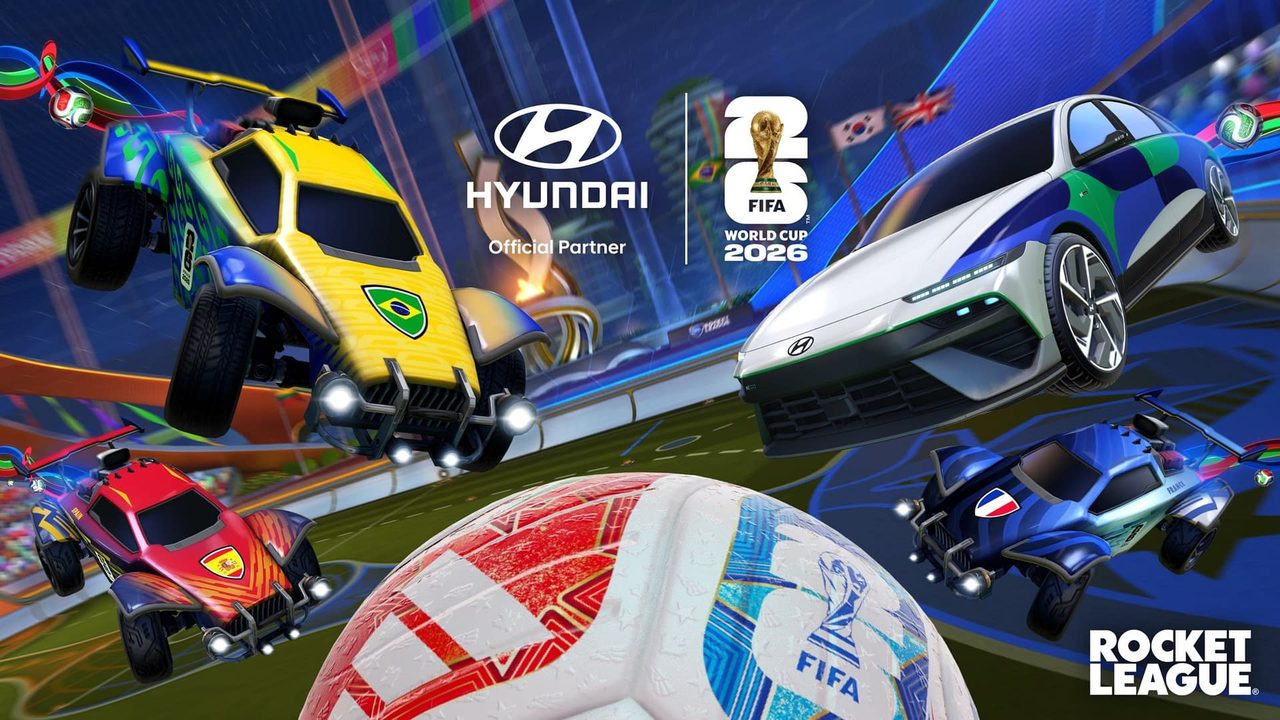
The news is not that a carmaker entered Fortnite and Rocket League. It is that a single brand activation now runs as synchronized live-ops across multiple games and physical venues at the same time.
Epic Games ran a Hyundai brand activation across two of its titles this summer, timed to the 2026 FIFA World Cup. In Rocket League, an event from June 11 to July 19, 2026 let players unlock the Hyundai IONIQ 6 N Line vehicle by completing 10 in-game challenges, then earn a FIFA World Cup 2026 decal by driving that car more than 8,000 meters while competing for one of the 48 qualified nations. A parallel Fortnite Limited Time Event ran June 25 to July 19, 2026, with weekly missions that unlocked the same IONIQ 6 N Line as a vehicle item and a World Cup decal usable as an in-game mobility tool. Offline, the campaign tied into FIFA World Cup exhibitions at Hyundai Motorstudio locations and gaming experience zones in Goyang and Busan, South Korea.
The real signal is not that a carmaker bought its way into a game. It is that one activation now stretches across two separate titles, two live-ops calendars, and physical venues on another continent, all locked to a single sports date. The working unit of a brand campaign is shifting from a placement you see to a presence you play, drive, and walk into over a five-week window.
Consider the coordination alone. Two titles built on different systems, a shared vehicle asset, a shared decal, weekly mission cadences, and museum-style exhibitions all had to ship on the same window and stay consistent for over a month. A few years ago that would have been three separate briefs handed to three separate teams. Here it is one campaign with one through-line, which tells you both the tooling and the expectations for cross-platform brand work have moved.
What a producer can build now
The mechanics are ordinary game systems reassigned as brand behavior. Ten challenges become a car; 8,000 meters driven become a decal; weekly missions become a reason to return. That reframes what a producer can promise a client: not an impression count but a countable action. Distance driven, challenges cleared and items equipped are all measurable, so a World Cup tie-in can report participation the way a game reports engagement, not the way a banner reports views. If you are scoping this kind of work, an activation toolkit that treats in-game actions as the primary metric is now a realistic ask rather than an experiment.

Why it belongs in an experiential toolkit
The offline side is the tell. The Motorstudio exhibitions and the experience zones in Goyang and Busan give the same campaign a physical room to stand in, so the in-game vehicle and the show-floor car point at each other. For experiential teams, that continuity, one asset and one story expressed both as a playable item and a built environment, is the part worth stealing. The game is not a channel bolted on at the end; it is the same activation rendered in a different medium, which is exactly how a well-run experiential program should think about every surface it owns.
That continuity is the layer we build. SensaLab is the white-label real-time 3D and immersive layer agencies and brands use to design and run experiences under their own name, so a single activation can read the same whether a person meets it in a game engine or on a show floor.