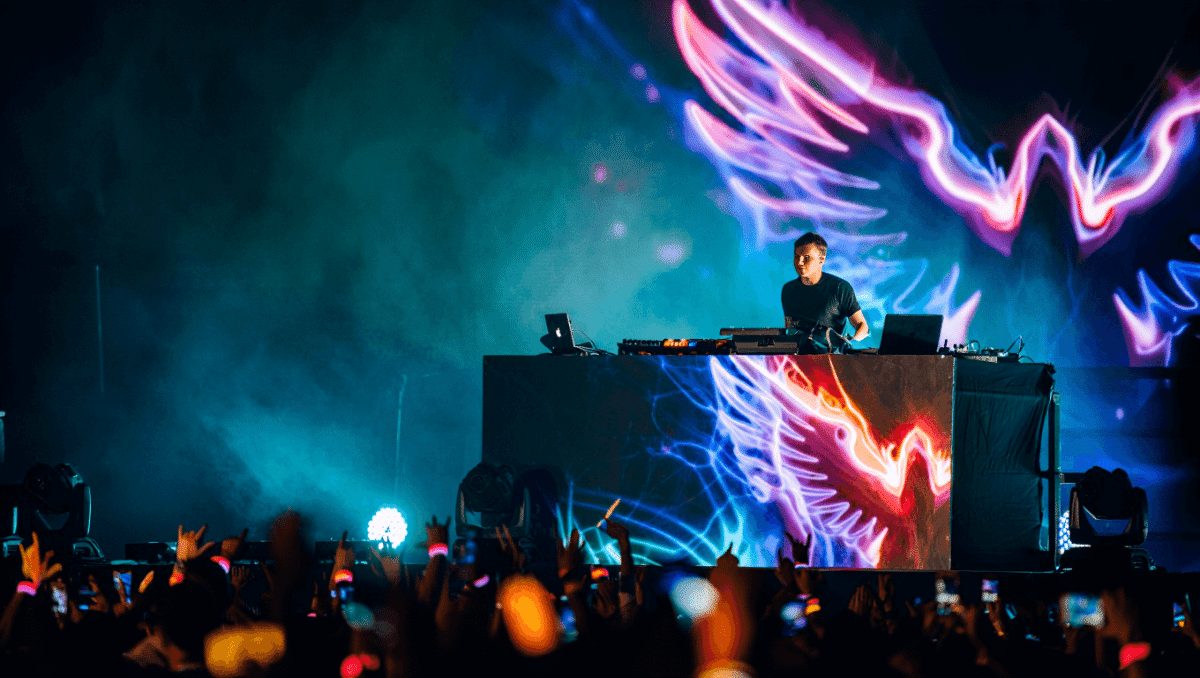
The news isn't that another DJ played Sphere. It's that a 65-person animation team, not a lighting rig, now defines what the room does.
Illenium's ODYSSEY residency runs nine shows across March 5-7, 12-14 and April 2-4, 2026, making him only the second electronic act to headline Sphere after Anyma, according to Art Threat. Berlin's Woodblock Animation Studios built the narrative with 65 animators working in Houdini, with content mapped to the venue's 160,000-square-foot wraparound interior LED screen. The story follows two warriors in a light-versus-dark arc tied to his album ODYSSEY, out February 6, 2026 on Republic Records.
The signal is where the work moved
The obvious read is that another headliner rented the biggest screen in Las Vegas. The real signal is a shift in where a show's value is created. When a single residency justifies 65 animators in Houdini for months, the production's center of gravity has moved from the lighting console to the render pipeline. The room is no longer a backdrop you light. It is a canvas you author, frame by frame, at a resolution that makes narrative, not just spectacle, the point.
That reframes the cost structure too. A traditional touring rig amortizes across dozens of dates; bespoke wraparound content amortizes across nine. The economics only work because the venue's scale turns animation into the headline act. For anyone pricing a large-format build, that is the number to internalize: the screen is cheap relative to the authored minutes that fill it.

What a producer can do now
If you brief immersive work, treat this as a planning template rather than a Sphere-specific stunt. Storyboard the narrative before you spec a single fixture, because the animation lead time, not the install, is now the critical path. Ask vendors how content is authored and mapped, not just how bright the panels are. And borrow the discipline of a fixed story spine: a two-character arc gave 65 people one thing to build toward, which is what keeps a project of this size from dissolving into loops and eye candy. If you are scoping a room-scale LED canvas, our Sphere-class venue playbook walks through how narrative content gets authored and mapped.
This belongs in an experiential toolkit because the technique travels down-market fast. The Houdini-to-LED pipeline that fills a 160,000-square-foot sphere is the same pipeline that fills a brand's flagship wall, a keynote stage, or a museum atrium, just at fewer pixels. Authored narrative content on wraparound LED is quickly becoming the default expectation for premium activations, not the exception, and the studios that can author it hold the leverage.
SensaLab is the white-label real-time 3D and immersive layer agencies and brands use to design and build room-scale experiences under their own name, so the narrative, the pipeline, and the credit stay yours.