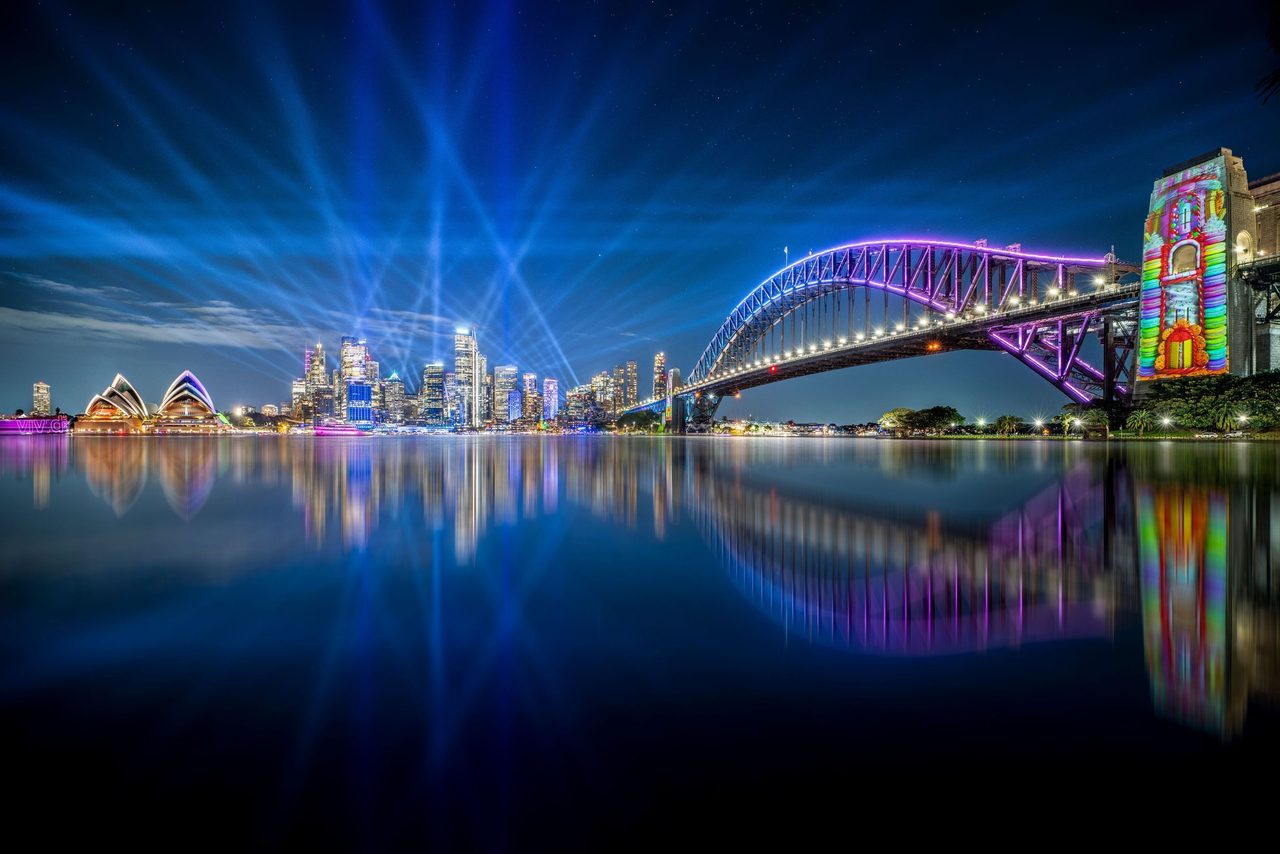
The news is not a bigger light festival. It is the quiet normalisation of scale, run nightly, that used to be a once-a-year stunt.
Vivid Sydney returns from 22 May to 13 June 2026, running 23 nights along an unbroken 6.5km Light Walk of more than 40 installations, according to Destination NSW. Chris Levine's 'Molecule of Light' becomes the tallest work in the festival's history at 23m high and 17m wide, visible across Sydney Harbour, while Reelize Studio's 'Obstacle' ranks among the longest ever at 45m. The program also stages a record 22 drone shows across 11 nights at Cockle Bay. Since its inception, Vivid has drawn more than 25 million visitors and generated over $1.3 billion in visitor spend.
The real signal is the calendar, not the centrepiece
The temptation is to read this as another bigger light festival. The sharper reading is the quiet normalisation of scale that used to be exceptional. A 23m installation and a 45m one are no longer stunts; they are anchor content on a route designed to hold a crowd for hours. Twenty-two drone shows across eleven nights turns a once-a-festival spectacle into scheduled, repeatable programming. The shift is from hero moment to hero calendar, and that is the part worth planning around.
That shift moves the cost centre. When the marquee is a single 45m structure, the budget is fabrication and logistics. When the marquee is a drone show run 22 times across 11 nights, the budget is choreography, show control, and the software that re-runs a complex sequence reliably in changing wind and crowd conditions. Producers who scope for the first and encounter the second lose the schedule, not just the margin, because a spectacle that has to fire on cue every night is an operations problem long before it is a creative one.

What a producer can do now
Treat 'flagship' as a system, not an object. Before committing to a single tall centrepiece, map how many times the experience has to fire, over how many nights, for how many people per hour. A live show package built around nightly repeats forces the right questions early: who owns show control, what the fail-safe is when a drone show scrubs, and how the walk keeps working when one node goes dark. Plan the route, too. Vivid's real differentiator is the unbroken 6.5km flow, not any single work, and flow is a design problem rather than a fabrication one.
Why it belongs in an experiential toolkit
Real-time rendering and networked show control are what make a hero calendar affordable. If your centrepiece is authored in an engine rather than built once in steel, you can re-theme it for a sponsor, localise it for a market, or reset it nightly without re-fabricating. That is the difference between a festival installation you strike at the end and a reusable experiential asset you can reprogram for the next brief.
SensaLab is the white-label real-time 3D and immersive layer agencies and brands use to design and run experiences under their own name, so the show control, the route, and the repeatable spectacle stay yours to schedule.